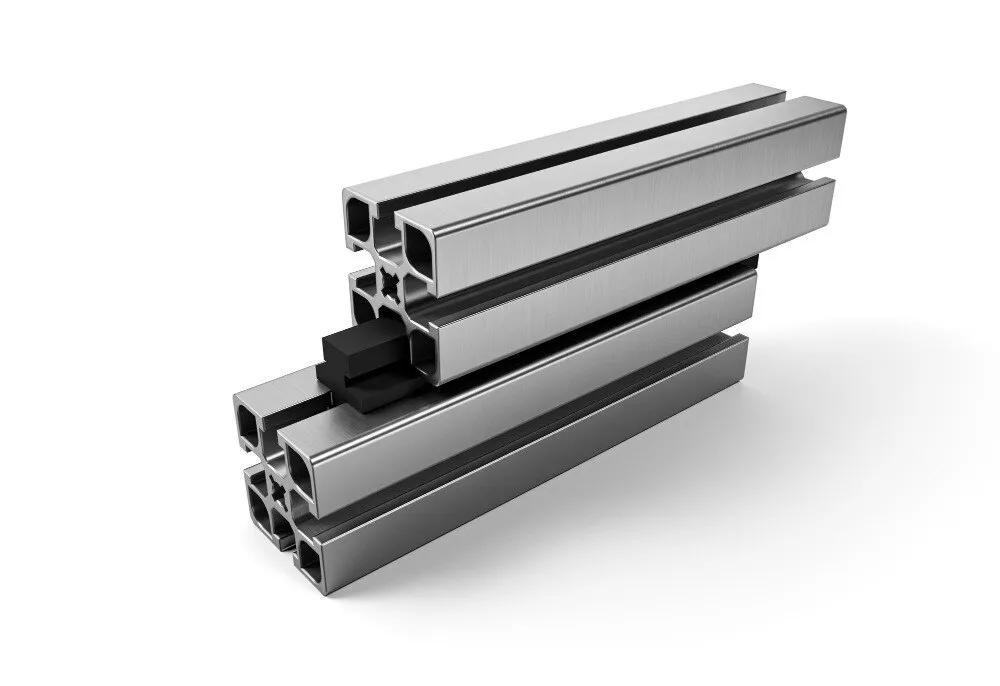
A T-slot profile is formed by pushing a heated aluminium billet through a purpose-built die, then correcting, ageing, cutting and inspecting the emerging section. By following each stage, you can distinguish a true extruded T-slot from a machined substitute and specify alloy, temper, dimensions, fasteners and tolerances with fewer production surprises.
Key takeaways
- Billet diameter and extrusion ratio determine press force, not profile size alone.
- A dedicated die forms the T-slots, bridges and hollow sections in one press stroke.
- Cooling, stretching, cutting and ageing control the profile’s final dimensions and temper.
- Specify alloy, temper, dimensions and compatible hardware before ordering a custom profile.
How the billet becomes a T-slot profile on the extrusion press
A cast-alloy billet becomes a T-slot profile through solid hot-working, not by pouring liquid aluminium into a mould. Alloy strength, billet diameter and extrusion ratio determine the required press force, so finished outside dimensions alone cannot select the press.
1. Select and cut the billet to press length. Heat it to roughly 450–520°C, where aluminium is soft enough to flow but remains solid. The exact temperature depends on alloy, section complexity, press design and speed; overheating can cause tearing, pickup or poor surface quality.
2. Preheat the T-slot die separately, commonly to about 400–480°C. A direct-extrusion ram then pushes the heated billet through the stationary die inside the container. Friction, billet diameter, alloy strength and extrusion ratio combine to set ram pressure and production speed.
3. Guide the emerging profile onto the runout table immediately. Rollers or other supports prevent the slot from rubbing or collapsing while controlled air or water spray lowers its temperature. Excessive or uneven cooling can introduce distortion before the profile is stretched.
4. Stretch the cooled length within its limited corrective range to reduce bow, twist and residual stress, then cut it for later ageing and inspection. Stretching cannot rescue severe die or process distortion.
For how t slot aluminium extrusion is made in mumbai, confirm whether one supplier performs billet preparation, pressing, cooling, stretching and cutting, or only selected stages. Request a stage-by-stage manufacturing declaration when traceability matters.
How a dedicated die creates the slots, bridges and hollow sections
A genuine T-slot profile needs a dedicated die because the slot opening, neck, flange and internal core must form in one press pass. The die’s core geometry directs aluminium around the opening, while bearing surfaces control flow and bearing length controls how long each section remains guided.
The steel body must resist press force without deflecting or cracking.
For enclosed or partly enclosed sections, a porthole or bridge die divides the billet around its bridges. The streams recombine under pressure in the welding chamber, leaving a longitudinal weld line. Place that line away from the most highly loaded orientation where the design permits, and include it in inspection for load-critical parts.
| Manufacturing route | Material waste and time | Surface and dimensional result |
|---|---|---|
| Die-made slot | No slot-cutting chips; one extrusion pass | Extruded surface, with slot width controlled by the die |
| Machined slot in rectangular stock | Removes material and adds setup, cutting and deburring time | Cut faces differ from the mill surface and may show tool marks |
Die wear gradually changes slot width, wall thickness and bearing balance. The resulting defects include die lines, uneven flow, twist and local distortion.
Check a custom T-slot aluminium extrusion in Mumbai against the drawing’s functional slot dimensions, not only its outside size; an opening that drifts can reject standard T-nuts even when the profile looks straight. A worn die also raises scrap and may require bearing correction or replacement.
How cooling, stretching, cutting and ageing establish the finished profile
After leaving the die, the profile travels along a guided run-out table while controlled air or water spray removes heat. Select the quench method and spray rate to achieve the alloy’s required cooling rate; excessive cooling can distort thin bridges, while insufficient cooling can miss the target temper.
Stretching then applies controlled tension to remove limited bow, twist and residual stress. It cannot rescue severe die imbalance or process distortion.
- Cut the straightened length with a supported saw to prevent slot crushing, then deburr or face the ends. Poor support leaves dents; a blunt blade creates burrs and tearing.
- Set the artificial-ageing furnace near 160–200°C for several hours, then fix the time and temperature from the alloy, section thickness and specified temper. Record the furnace chart for every batch.
- Inspect straightness, twist, bow and slot width against drawing datums. Adjust quench uniformity, bearing balance or stretching alignment when these dimensions drift.
- Inspect dents, scratches, blistering, tearing, pick-up and die lines. Correct handling, table cleanliness, lubrication, die condition or extrusion speed rather than hiding marks with coating.
- Check cut-end squareness, burrs and crushing. Correct saw alignment, blade condition, clamping and end support.
| Temper | Thermal history | Practical implication |
|---|---|---|
| T5 | Cooled from the hot shaping process, then artificially aged | Properties depend on extrusion cooling and ageing control |
| T6 | Solution heat-treated, then artificially aged | Adds a separate solution-treatment step before ageing and targets different mechanical properties |
A final inspection report should record alloy, temper, batch, cut length, critical slot dimensions and the measured defects, not just confirm that the profile “passed.”
How alloy, temper, dimensions and hardware compatibility change the result
Define the alloy and temper before comparing profiles: 6060 and 6063 usually extrude faster and produce cleaner surfaces for anodising or powder coating, while 6061 delivers higher strength but demands more press force and brings a less favourable finish and throughput trade-off.
| Alloy | Extrusion and finish result | Suitable use |
|---|---|---|
| 6060 | Fast extrusion, smooth surface and good finishing response | Architectural and modular frames |
| 6063 | Very good surface quality and efficient extrusion | Visible profiles and general frames |
| 6061 | Higher strength, harder extrusion and less favourable finish/throughput | Strength-critical frames |
Put these requirements on the drawing and purchase order:
- Outside dimensions, wall thickness, slot opening, nominal slot size, core geometry, corner radius, straightness, cut length, alloy, temper, finish and critical tolerances.
- Datum references, centre-to-centre spacing, squareness and functional slot dimensions, not only a general tolerance.
- EN 755-9 with the applicable edition, or ASTM B221/B221M with the applicable edition; write the edition number instead of “as per standard.”
Confirm that the profile accepts the exact standard T-nuts, roll-in nuts, corner brackets and joining plates you intend to use. A 6063 profile with a narrow opening can reject a nominally compatible nut.
Anodising and powder coating occur after extrusion and cutting. Coating thickness can reduce slot clearance, so test finished samples with actual fasteners, covers and plates. The phrase t slot aluminium profile supply in mumbai does not establish these dimensions or compatibility; request a measured sample and inspection record before approval.
What happens when you order a custom T-slot extrusion in Mumbai
A custom T-slot aluminium extrusion in Mumbai starts with a drawing, not a catalogue description. Submit a 2D section drawing or CAD file that identifies:
- Slot series and compatible T-nuts, roll-in nuts, brackets and joining plates
- Alloy, temper, critical tolerances, cut lengths and finish
- Quantity or annual volume and intended loading
1. The supplier checks manufacturability, including bridge strength, bearing lengths, wall thickness and likely metal flow. Ask whether the design suits the available press capacity and whether the slot will remain functional after anodising or powder coating.
2. The quotation should separate die cost from aluminium cost, state the minimum economical run and give a die lead time. A small trial can still be uneconomic because die design, manufacture, trial extrusion and process adjustment cost nearly the same whether the aluminium order is modest or large.
3. After die manufacture, the supplier runs a trial extrusion, then checks dimensions, straightness, slot fit and assembly with the specified fasteners. You approve samples before production release.
4. Request alloy and temper certificates, inspection records, die ownership or source, straightening method, cut-length capability, surface-treatment route and a stage-by-stage manufacturing declaration.
“T slot aluminium profile supply in Mumbai” does not prove local extrusion; the stock may be imported, mill-extruded elsewhere or machined from standard bar. When comparing a T-slot aluminium extrusion manufacturer in Mumbai, ask those production questions. Aluminium World can be considered alongside other Mumbai suppliers on that evidence, rather than catalogue wording alone.
Related products
 | Aluminium Extrusions Minimum Order Quantity: 50 Kg Shape Square Usage/Application Construction Thickness 12 mm Surface Finishing Polished Packaging Type Loose Material... View product → |
 | Aluminium Extrusions Minimum Order Quantity: 50 Kg Usage/Application Construction Thickness 13 mm Surface Finishing Polished Alloy Or Not Is Alloy Material Grade 8020... View product → |
Frequently asked questions
How does an aluminium billet become a T-slot profile on an extrusion press?
A cast-alloy billet is heated and pushed through a shaped die under high pressure. Solid hot-working forces the aluminium through the die opening and creates the continuous T-slot profile.
How does the extrusion die create T-slots, bridges and hollow sections?
The die opening contains the required slot geometry, bridges and hollow-forming features. Its design controls metal flow, wall thickness, slot dimensions and the profile’s final cross-section.
What steps establish the finished T-slot profile?
After leaving the die, the profile is cooled, stretched to correct straightness and stress, cut to length and artificially aged to reach the specified temper.
What should you specify when ordering a custom T-slot extrusion in Mumbai?
Provide the alloy, temper, cross-sectional drawing, tolerances, cut lengths, quantity, slot dimensions and hardware requirements. Confirm that nuts, bolts, covers and connectors fit the slot before production.
Keywords