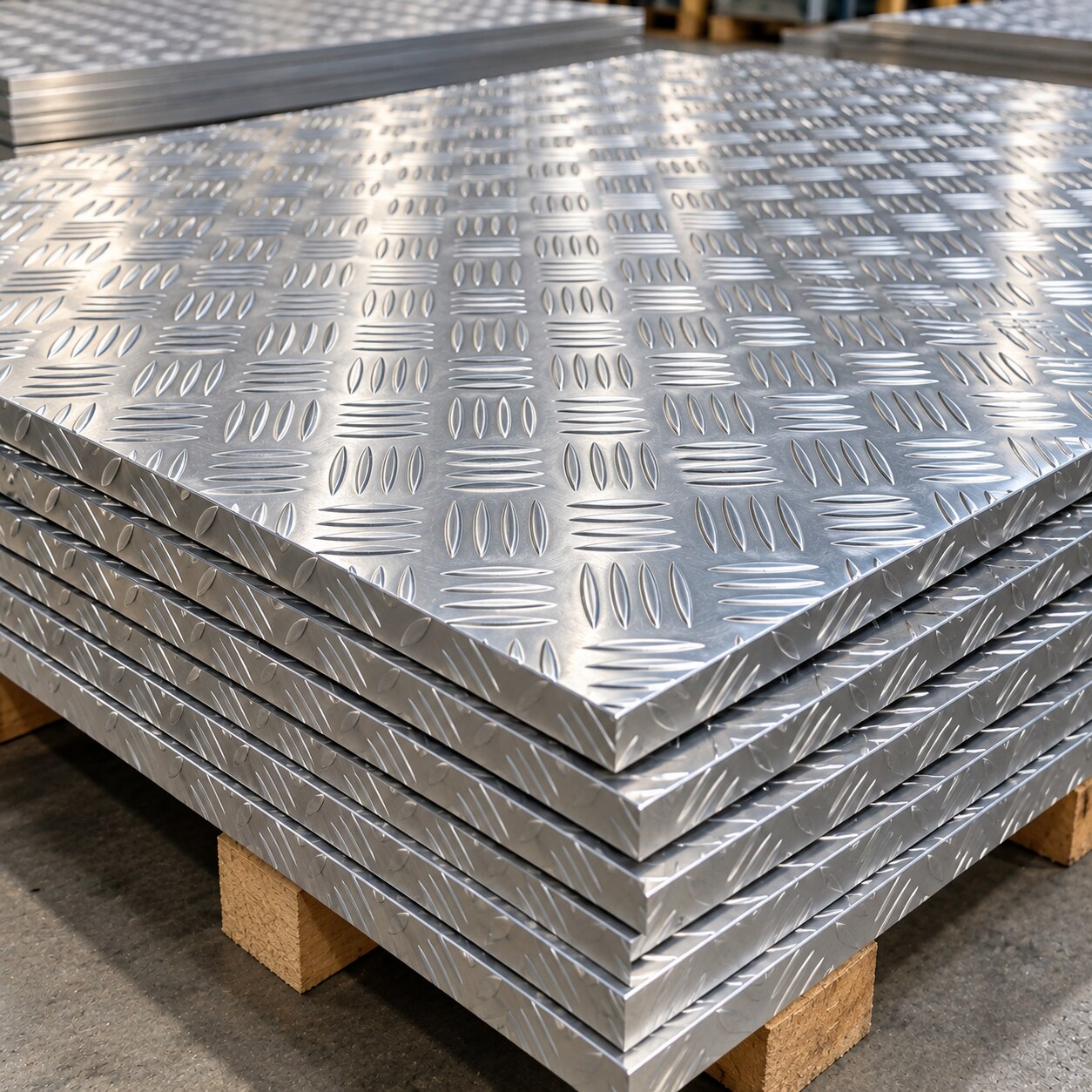
Cement dust, monsoon moisture, coastal salt, steel swarf and oil do more damage when they remain trapped in the raised pattern, grooves, edges or fastener zones. You will be able to choose a finish-safe cleaning method, set inspection intervals and decide whether a marked plate needs cleaning, repair, isolation or replacement.
Key takeaways
- Confirm the finish and coating record before choosing a cleaner.
- Rinse salt, cement dust and cleaner residue with clean water.
- Brush pattern grooves, edges and joints where moisture collects.
- Replace plate weakened by deep corrosion, cracks or unsafe deformation.
Identify the finish and contamination before you clean
Start by identifying the surface finish, because a cleaner safe for mill-finish aluminium can dull anodising or attack a powder-coated film. For patterned aluminium chequered plate maintenance in Mumbai, check the purchase specification, alloy and coating record before testing a hidden edge; appearance alone is not proof.
| Finish | Recognisable clue | Safe first method |
|---|---|---|
| Mill-finish aluminium | Uneven natural silver surface with no continuous coloured film | Fresh water, then diluted pH-neutral detergent and a soft nylon brush |
| Anodised aluminium | Uniform metallic colour with a thin, even protective layer | Test pH-neutral detergent on an underside area; stop if colour or sheen changes |
| Powder-coated aluminium | Continuous coloured or textured film over the raised pattern | Use only a coating-compatible neutral cleaner after a concealed-area test |
Identify the deposit without scraping it. White, hard crust suggests dried cement or salt; brown-orange marks suggest rust transfer; black or rainbow discolouration near welds suggests welding residue; greasy dark smears indicate oil. Wet cement and slurry need immediate water flushing because alkaline residue can etch aluminium. Salt needs fresh-water rinsing before it dries repeatedly.
Use a low-pressure pre-rinse and inspect the grooves, tread recesses, cut edges and fastener zones. Do not wipe dry dust, use abrasive pads, or apply hydrochloric acid, caustic soda or chlorine products before the finish is confirmed. Record the finish, suspected contaminant, test patch, cleaner and photographs, especially after monsoon exposure or a coastal spill.
A safe cleaning procedure for Mumbai construction sites
Start while cement, mud and salt are still wet. Dry wiping embossed aluminium drags grit across the finish, while hardened alkaline slurry can etch and discolour it. A reliable approach to aluminium chequered plate cleaning in Mumbai uses cool-to-lukewarm fresh water, not heat.
1. Isolate the area and let welding residue cool completely. Remove loose dust, grit and mud with a low-pressure fresh-water pre-rinse, directing water away from electrical equipment and drainage-sensitive areas.
2. Mix a pH-neutral, aluminium-safe detergent at the manufacturer’s dilution in water at approximately 20–30°C. Apply it with a pump sprayer or soft sponge; do not use hydrochloric acid, phosphoric-acid descaler, caustic soda, chlorine bleach or abrasive household cleaner.
3. Treat cement splash immediately with plenty of fresh water. For oil, use the same neutral detergent or an aluminium-safe neutral degreaser; leave it wet for 5–10 minutes, never until the film dries.
4. Brush the tread recesses and flats with a soft nylon brush, following the pattern. Use a plastic scraper only on softened wet cement; never use steel wool, wire brushes or abrasive pads, which cut the surface and leave embedded iron.
5. Rinse thoroughly with fresh water until no foam, grit, oil sheen or cement haze remains. Coastal salt needs this rinse after every exposure; do not let saline deposits dry repeatedly.
6. Squeegee or wipe with clean microfiber cloths, then dry edges, laps and fastener zones. Record any remaining pitting, coating loss or welding stain before reopening the work area.
Clean the pattern, edges and hidden moisture traps
Water left in a tread recess is not harmless: it carries salt and grit against aluminium until pitting starts. Chequered plate care on construction sites therefore means cleaning below the visible pattern, not just wiping the raised diamonds.
- Lift rubber-backed mats, edge trims and stored materials before inspection. Wash and dry the plate beneath them; replace mats only when both surfaces are dry.
- Brush recesses and grooves with a soft nylon brush, then flush them with low-pressure fresh water. Do not use a dry cloth on cement dust or grit, which can scratch the finish.
- Clear mud and debris from cut-outs and drainage paths. A blocked opening turns rainwater into a standing pool at the plate edge.
- Clean around fastener heads and washers, then dry the annular gap. Check for trapped water beneath laps and overlaps; separate them only under the approved site procedure, and do not force a joint that supports a load.
- Inspect the underside at accessible edges, brackets and drain points. Remove salt deposits and welding residue, rinse with fresh water, and dry with clean air or a lint-free cloth.
Keep dissimilar-metal fittings dry against aluminium, especially copper and carbon-steel hardware. Use compatible fasteners or electrically isolate the contact with an insulating washer or coating, then eliminate puddles around the detail.
During construction, shield the pattern from wet cement and remove splashes with plenty of water before they harden; scraping cured alkaline residue can etch the plate.
Set a Mumbai inspection and maintenance schedule
Inspect high-traffic floors, loading bays, marine-facing façades and industrial areas every month. Inspect sheltered indoor plate every three months, then inspect again after the monsoon and immediately after cement, chemical or oil spills. Rinse outdoor coastal plate with fresh water whenever salt spray or deposits appear; do not let salt dry repeatedly.
Use this inspection checklist:
- Lift rubber-backed mats, stored materials and edge trims; check overlaps, cut-outs, fastener washers, drainage paths and the underside.
- Confirm cleaning has succeeded when the tread recesses contain no salt, cement dust, oily film, grit or mud, the surface has no cleaner residue, water drains freely, and the plate dries without dark damp lines.
- Treat white powder, pits, rough swelling, blistered coating, flaking finish or dark crevice staining as damage requiring attention.
- Check orange-brown specks separately. Steel swarf from grinding, drilling or cutting can stain aluminium and must be removed without rubbing it deeper.
- Photograph recurring deposits and record the alloy or finish, cleaner, dilution, rinse method, location of pitting or finish loss, and date.
Shorten the inspection interval after repeated staining, standing water, saline spray or heavy construction activity. This record supports patterned aluminium plate upkeep in Mumbai by stopping an unsuitable cleaner from being reused on a different finish. Isolate areas with spreading pitting, sharp damaged edges or fastener-zone failure for a repair decision.
When to polish, repair, isolate or replace the plate
Polish only damage that changes appearance: light scuffs, water marks, surface dulling and removable transfer from rubber or packaging. These defects do not reduce thickness or bearing capacity, but aggressive polishing can thin the raised tread or strip an anodised or powder-coated finish.
Treat the plate as a safety issue when you find any of these conditions:
- Isolate it immediately if it flexes, rocks, has a sharp torn edge, a through-hole, a split, buckling or permanent deflection under normal traffic.
- Repair a local, non-load-bearing defect only after removing the cause of trapped water, galvanic contact or impact. Do not cover active pitting with sealant or a cosmetic patch.
- Replace it when pitting has reduced the section, fastener holes are enlarged, an overlap has separated, corrosion has reached the underside, or the support beneath has weakened.
- Obtain a competent engineer’s assessment before reopening a load-bearing floor, ramp, platform or access cover. Thickness alone cannot prove safety; span, alloy, temper, support spacing, fastener layout and imposed load also control capacity.
For patterned aluminium chequered plate maintenance in Mumbai, inspect beneath mats, overlaps and washers after the monsoon or any chemical spill. Chequered plate care in construction fails when the visible top looks clean but concealed corrosion remains.
When ordering a replacement, give Aluminium World the measured span, support spacing, thickness, alloy or temper, finish and fixing method so a visually similar plate is not substituted for a structurally suitable one.
Related product
 | Aluminium Plate Patterned Aluminium Chequered Plate ₹ 280/KgGet Latest Price Minimum Order Quantity: 100 Kg Thickness 14 mm Usage/Application Construction Pattern Chequered Is It Anodised Anodised... View product → |
Frequently asked questions
How do you identify contamination before cleaning aluminium chequered plate?
Check for salt deposits, cement dust, oil, adhesive, paint, standing water and white corrosion residue. Confirm the alloy, finish and coating record before testing a cleaner on a hidden edge.
What is a safe cleaning procedure for chequered plate on Mumbai construction sites?
Remove loose grit, wash with clean water and a mild pH-neutral detergent, agitate with a soft nylon brush, rinse thoroughly and dry the plate. Avoid abrasive pads, strong acids, caustic cleaners and chloride-containing products.
How should you clean the pattern, edges and hidden moisture traps?
Work across each raised tread and into the recessed areas with a soft brush. Clear cement and dirt from cut edges, fastener holes, laps, joints and underside contact points, then dry trapped moisture.
How often should Mumbai sites inspect patterned aluminium chequered plate?
Inspect after monsoon events, chemical spills, cement work and pressure washing. Add routine checks to the site maintenance log, focusing on joints, edges, fixings, underside contact points and areas exposed to salt-laden air.
When should you polish, repair, isolate or replace chequered plate?
Polish only when the finish record permits it and use a non-abrasive method. Repair compatible surface damage, isolate plates exposed to incompatible metals or chemicals, and replace sections with deep pitting, cracks, dangerous distortion or loss of load-bearing thickness.
Keywords