The right choice depends on more than whether a sheet has a decorative face. You need to compare the aluminium alloy and temper, coating construction, exposure conditions, fabrication method, maintenance demands and end-of-life requirements before treating either option as suitable.
Key takeaways
- Confirm whether the PVC layer is laminated film, liquid coating, or decorative film.
- Choose plain aluminium for exposed heat, solvents, or demanding forming work.
- Compare alloy, temper, thickness, coating build, warranty and test reports—not price alone.
- Inspect adhesion, scratches, edges, fasteners and drainage before installation.
What actually differs between PVC-coated and plain aluminium sheets?
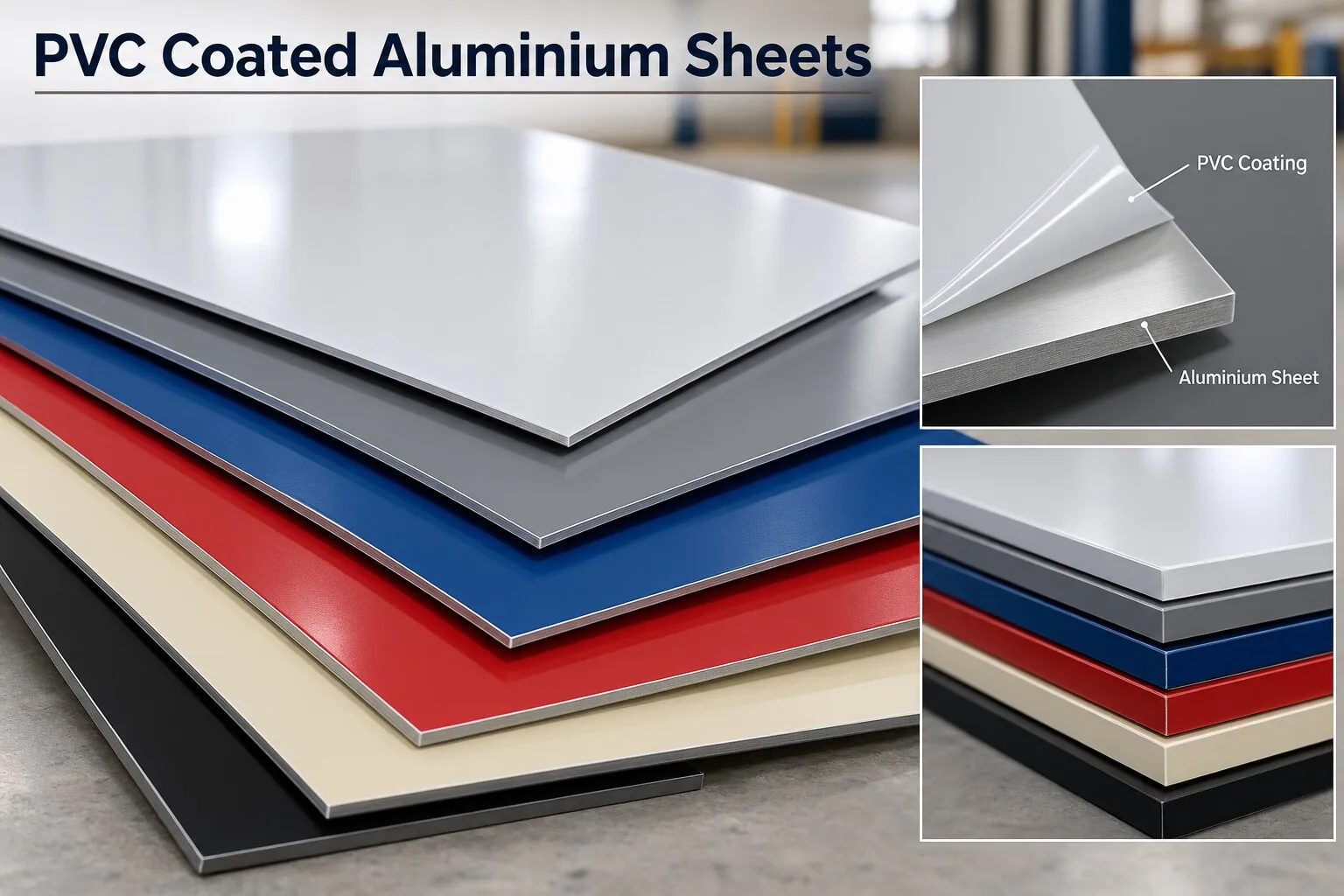
PVC-coated aluminium is not one standard construction. It may be an adhesive-laminated PVC film, a liquid PVC-based coating, or a decorative film applied over primer. The phrase pvc coated aluminium sheets versus plain sheets is useful only after you identify what is actually on the metal.
| Construction | What differs | What to confirm |
|---|---|---|
| Adhesive-laminated film | PVC film bonded to aluminium | Film thickness, adhesive and peel performance |
| Liquid PVC coating | PVC-based layer applied and cured on the surface | Coating thickness, cure and finish |
| Primer-backed film | Decorative film bonded over primer | Primer system, film thickness and compatibility |
For a like-for-like pvc coated versus plain aluminium sheet comparison, request:
- Aluminium alloy and temper, aluminium thickness, PVC or coating thickness, adhesive or primer system, and total thickness
- Finish, colour or texture, protective film, and whether one or both faces are coated
- The one-face arrangement is common; confirm two-face coating in writing
A cut edge, drilled hole, scratch or fastener penetration breaks the film’s barrier. Salt air, industrial fumes, standing water and contact with dissimilar metals can then attack exposed aluminium, even when the visible face looks intact.
Plain aluminium exposes the metal and can later receive anodising, powder coating or paint. Its inherent corrosion resistance is not the same as protection supplied by a film. A listed 5052 anodised sheet is not automatically equivalent to untreated plain aluminium: compare alloy, temper, thickness and surface condition, not the product name alone.
How do appearance, maintenance and service conditions change the decision?
The practical PVC coated aluminium sheet benefits are visual: factory-applied colour and texture, fewer fingerprints, simpler cleaning and a facing that hides light handling marks. The film can provide limited noise or thermal separation, but performance depends on film thickness, backing, adhesive and the complete panel assembly.
| Option | Appearance and maintenance | Service-condition advantage |
|---|---|---|
| PVC-coated | Consistent decorative finish; easier cleaning; hides minor marks | Useful on visible interior surfaces away from high heat |
| Plain aluminium | Scratches remain visible; may need paint or another treatment | Better UV stability, heat resistance and repairability |
PVC does not eliminate maintenance. Water at edges, poor surface preparation, incompatible sealants and restrained thermal movement can cause peeling, bubbling, blistering, delamination, UV fading, embrittlement, adhesive failure and edge lifting.
Do not accept “heat resistant” near exhausts, cooking lines, radiant heaters or hot pipework. Request the stated service-temperature limit for the exact film, adhesive and assembly.
For fire-sensitive work, request a test report for the complete assembly under EN 13501-1 or the locally mandated equivalent. The facing, adhesive, core, joints and substrate determine flame spread and smoke; an aluminium substrate alone is not a fire certificate.
For exterior use, request evidence covering:
- UV exposure and colour retention
- Water exposure and peel or delamination resistance
- The intended exposure class and edge protection
A decorative interior-grade PVC film can fade or lose adhesion outdoors even when the aluminium beneath remains sound.
Which sheet suits fabrication and specific applications?
Choose PVC-faced sheet for appearance-led interior work, and choose plain aluminium when fabrication, heat, exposure or later repair controls the decision. Typical PVC aluminium sheet applications include interior wall and column cladding, partitions, false-ceiling details, shopfitting, cabinet and furniture panels, signage, elevator interiors, and decorative door or window infill.
| Option | Best suited to | Main caution |
|---|---|---|
| PVC-faced sheet | Cleanable interiors, fingerprints, factory colour and texture | The face can crack, whiten, stretch or detach during forming |
| Plain aluminium | Bending, hems, drilling, punching, field cuts, welding, grinding and repair | Scratches remain visible unless you refinish the surface |
| Either, after verification | Roofing, exposed cladding, vehicle bodies, signage and decorative fabrication | Check exposure, impact, forming, colour retention and repair requirements |
Plain aluminium is usually safer for repeated bends and tight radii because you can select an appropriate alloy-temper combination and refinish the metal. Require a trial bend using production tooling when the part has a hem, return or tight fold.
For roofing or exposed wall cladding, specify PVC only with an exterior exposure rating, UV and colour-retention evidence, protected edges and a stated temperature limit. Otherwise use plain aluminium with anodising, paint or powder coating. Plain sheet is also the safer choice for ducting, machine guards and hot equipment.
The pvc coated versus plain aluminium sheet decision affects service life more than the label suggests. Environment, edge detailing, fasteners and maintenance determine performance; a PVC face is unsuitable near hot exhausts, cooking lines or radiant heaters without product-specific limits. Coastal or industrial exposure requires extra scrutiny.
How should you compare quotations and test the material before purchase?
Compare quotations only after making every supplier price describe the same material, usable area and evidence package.
| Option | What to normalise | What to confirm |
|---|---|---|
| Plain aluminium sheet | ASTM B209/B209M or equivalent; alloy, temper, thickness, dimensions, tolerances and mechanical requirements | Surface condition, usable sheet size, protective film and delivery scope |
| PVC-coated sheet | Aluminium specification plus PVC-film or coating thickness, adhesive or primer, total weight per square metre, colour, texture and gloss | One-face or two-face coverage, protective film, edge treatment and minimum order quantity |
| Commercial offer | Price against usable sheet size, quantity and specification | Delivered lead time, freight, taxes, test documents and replacement terms |
Request these items in writing:
- For the coating, record thickness tolerance, colour and gloss tolerance, face coverage and the manufacturer’s pass criteria.
- Ask for ASTM D3359 tape-adhesion, ASTM D3363 pencil-hardness and ASTM D523 gloss test records, including substrate preparation, conditioning and test direction.
- Request exposure, peel, water and temperature evidence for exterior work, plus a complete-assembly fire report where the project requires it. Those three ASTM tests do not prove outdoor durability or fire performance.
- Reject a quote that hides a thinner backing, lower-grade film, narrower dimensions or omitted edge treatment.
When evaluating a pvc coated aluminium sheet supplier in mumbai, ask Aluminium World to clarify alloy, temper, finish, fabrication limits, test documents, colour tolerance and delivery scope. Treat the discussion as a specification review: pvc coated aluminium sheets versus plain sheets cannot be compared by catalogue names alone.
Related products
 | Aluminium Sheets & Plates Pvc Coated Aluminum Sheets PVC Coated Aluminum Sheets are aluminum sheets coated with PVC for enhanced corrosion resistance and durability, commonly... View product → |
 | Aluminium Products Anodised Aluminium Sheet is treated to provide enhanced corrosion resistance, durability, and a premium finish. View product → |
What installation and lifecycle details prevent premature failure?
Installation choices can decide the PVC-coated versus plain aluminium sheet outcome. PVC and aluminium expand at different rates, so long panels, dark colours, bonded assemblies and direct sun need movement allowances; restrained joints can bow panels, stress fasteners, lift edges or break adhesive bonds.
Follow the system supplier’s data for joint spacing, fixing slots, adhesive coverage, perimeter detailing and minimum bend radius. Do not copy plain-sheet practice for PVC aluminium sheet applications.
Use this installation checklist:
- Protect cut edges, seal drilled holes and detail fastener penetrations so water cannot reach the backing.
- Choose compatible fasteners, separate aluminium from dissimilar metals and provide drainage at joints.
- Use the specified adhesive coverage and allow movement instead of creating a rigid, continuous bond.
- Keep aggressive solvents, grinding and welding away from the finished PVC face.
- Replace damaged film; do not assume the aluminium beneath remains unaffected.
- In coastal Mumbai, inspect edges, fasteners, stains, bubbling and moisture entry. PVC can hide corrosion until water reaches an exposed edge or hole.
Plain, unpainted aluminium is easier to recover as a clean, high-value scrap stream. PVC-faced sheet combines aluminium, PVC, adhesive, primer and protective film, so ask whether the layers are separable, identify the facing system and segregate offcuts.
Choose after weighing appearance and easier cleaning against heat, UV exposure, repair, fabrication, maintenance and recycling. A coating label alone does not settle the lifecycle decision.
Frequently asked questions
What actually differs between PVC-coated and plain aluminium sheets?
PVC-coated sheets have a polymer layer over the aluminium, while plain sheets expose the mill, anodised or painted metal surface. Confirm whether the coating is laminated PVC film, liquid PVC-based coating or decorative film over primer.
When should you choose PVC-coated aluminium over plain aluminium?
Choose PVC-coated aluminium when surface appearance, colour consistency, easier cleaning or added scratch protection matters. Choose plain aluminium when high heat, solvents, aggressive forming or coating repairability controls the decision.
Which sheet is better for fabrication and specific applications?
Match the sheet to alloy, temper, thickness, bend radius, joining method and service exposure. PVC aluminium suits selected wall panels, partitions, interiors and decorative work; plain aluminium suits fabrication that needs direct forming, welding or exposed-metal performance.
How should you compare aluminium sheet quotations before purchase?
Compare alloy and temper, nominal thickness, sheet size, PVC construction, coating or film thickness, colour reference, protective masking, tolerances, batch details, warranty and test reports. Request a sample and inspect coating adhesion, edges, scratches and forming behaviour before ordering.
What installation details prevent premature failure?
Protect the face during cutting, avoid damaging the coating at drilled holes and edges, use compatible fasteners and sealants, allow for thermal movement, and prevent water from remaining against unsealed edges.
Keywords